Saturday, 19 November 2016

Inductor Construction


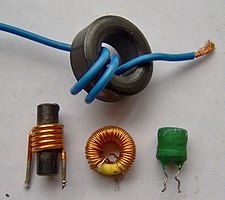
An inductor usually consists of a coil of conducting material, typically insulated copper wire, wrapped around a core either of plastic or of a ferromagnetic (or ferrimagnetic) material; the latter is called an "iron core" inductor. The high permeability of the ferromagnetic core increases the magnetic field and confines it closely to the inductor, thereby increasing the inductance. Low frequency inductors are constructed like transformers, with cores of electrical steel laminated to prevent eddy currents. 'Soft' ferrites are widely used for cores above audio frequencies, since they do not cause the large energy losses at high frequencies that ordinary iron alloys do. Inductors come in many shapes. Most are constructed as enamel coated wire (magnet wire) wrapped around a ferrite bobbin with wire exposed on the outside, while some enclose the wire completely in ferrite and are referred to as "shielded". Some inductors have an adjustable core, which enables changing of the inductance. Inductors used to block very high frequencies are sometimes made by stringing a ferrite bead on a wire.

                                                Image result for inductor
Small inductors can be etched directly onto a printed circuit board by laying out the trace in a spiral pattern. Some such planar inductors use a planar core.
Small value inductors can also be built on integrated circuits using the same processes that are used to make transistors. Aluminium interconnect is typically used, laid out in a spiral coil pattern. However, the small dimensions limit the inductance, and it is far more common to use a circuit called a "gyrator" that uses a capacitor and active components to behave similarly to an inductor

Application of inductors

Inductors are used extensively in analog circuits and signal processing. Applications range from the use of large inductors in power supplies, which in conjunction with filter capacitorsremove residual hums known as the mains hum or other fluctuations from the direct current output, to the small inductance of the ferrite bead or torus installed around a cable to prevent radio frequency interference from being transmitted down the wire. Inductors are used as the energy storage device in many switched-mode power supplies to produce DC current. The inductor supplies energy to the circuit to keep current flowing during the "off" switching periods.


An inductor connected to a capacitor forms a tuned circuit, which acts as a resonator for oscillating current. Tuned circuits are widely used in radio frequency equipment such as radio transmitters and receivers, as narrow bandpass filters to select a single frequency from a composite signal, and in electronic oscillators to generate sinusoidal signals.
Two (or more) inductors in proximity that have coupled magnetic flux (mutual inductance) form a transformer, which is a fundamental component of every electric utility power grid. The efficiency of a transformer may decrease as the frequency increases due to eddy currents in the core material and skin effect on the windings. The size of the core can be decreased at higher frequencies. For this reason, aircraft use 400 hertz alternating current rather than the usual 50 or 60 hertz, allowing a great saving in weight from the use of smaller transformers.[5]


Inductors are also employed in electrical transmission systems, where they are used to limit switching currents and fault currents. In this field, they are more commonly referred to as reactors.
Because inductors have complicated side effects (detailed below) which cause them to depart from ideal behavior, because they can radiate electromagnetic interference (EMI), and most of all because of their bulk which prevents them from being integrated on semiconductor chips, the use of inductors is declining in modern electronic devices, particularly compact portable devices. Real inductors are increasingly being replaced by active circuits such as the gyrator which can synthesize inductance using capacitors.

Introduction about inductors

An inductor, also called a coil or reactor, is a passive two-terminal electrical component which resists changes in electric current passing through it. It consists of a conductor such as a wire, usually wound into a coilEnergy is stored in a magnetic field in the coil as long as current flows. When the current flowing through an inductor changes, the time-varying magnetic field induces a voltage in the conductor, according to Faraday’s law of electromagnetic induction. According to Lenz's law the direction of induced electromotive force(or "e.m.f.") is always such that it opposes the change in current that created it. As a result, inductors always oppose a change in current, in the same way that a flywheel opposes a change in rotational velocity. Care should be taken not to confuse this with the resistance provided by a resistor.
      Electronic component inductors.jpg
An inductor is characterized by its inductance, the ratio of the voltage to the rate of change of current, which has units of henries (H). Inductors have values that typically range from 1 µH (10−6H) to 1 H. Many inductors have a magnetic core made of iron or ferrite inside the coil, which serves to increase the magnetic field and thus the inductance. Along with capacitors and resistors, inductors are one of the three passive linear circuit elements that make up electric circuits. Inductors are widely used in alternating current (AC) electronic equipment, particularly in radio equipment. They are used to block AC while allowing DC to pass; inductors designed for this purpose are called chokes. They are also used in electronic filters to separate signals of different frequencies, and in combination with capacitors to make tuned circuits, used to tune radio and TV receivers.