Inductors are used extensively in analog circuits and signal processing. Applications range from the use of large inductors in power supplies, which in conjunction with filter capacitorsremove residual hums known as the mains hum or other fluctuations from the direct current output, to the small inductance of the ferrite bead or torus installed around a cable to prevent radio frequency interference from being transmitted down the wire. Inductors are used as the energy storage device in many switched-mode power supplies to produce DC current. The inductor supplies energy to the circuit to keep current flowing during the "off" switching periods.

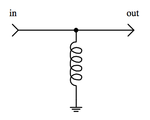
An inductor connected to a capacitor forms a tuned circuit, which acts as a resonator for oscillating current. Tuned circuits are widely used in radio frequency equipment such as radio transmitters and receivers, as narrow bandpass filters to select a single frequency from a composite signal, and in electronic oscillators to generate sinusoidal signals.
Two (or more) inductors in proximity that have coupled magnetic flux (mutual inductance) form a transformer, which is a fundamental component of every electric utility power grid. The efficiency of a transformer may decrease as the frequency increases due to eddy currents in the core material and skin effect on the windings. The size of the core can be decreased at higher frequencies. For this reason, aircraft use 400 hertz alternating current rather than the usual 50 or 60 hertz, allowing a great saving in weight from the use of smaller transformers.[5]
Inductors are also employed in electrical transmission systems, where they are used to limit switching currents and fault currents. In this field, they are more commonly referred to as reactors.
Because inductors have complicated side effects (detailed below) which cause them to depart from ideal behavior, because they can radiate electromagnetic interference (EMI), and most of all because of their bulk which prevents them from being integrated on semiconductor chips, the use of inductors is declining in modern electronic devices, particularly compact portable devices. Real inductors are increasingly being replaced by active circuits such as the gyrator which can synthesize inductance using capacitors.

No comments:
Post a Comment